World Maritime Day in 2025 will be observed on 25 September, continuing a tradition established by the International Maritime Organization (IMO) to highlight the essential role of shipping and seafarers in global trade and sustainable development. Each year, the day is marked by a unifying theme chosen by the IMO to focus global attention on key maritime issues. These range from safety at sea, technological innovation, and maritime education, to pressing challenges such as decarbonisation, digitalisation, and the protection of marine ecosystems.
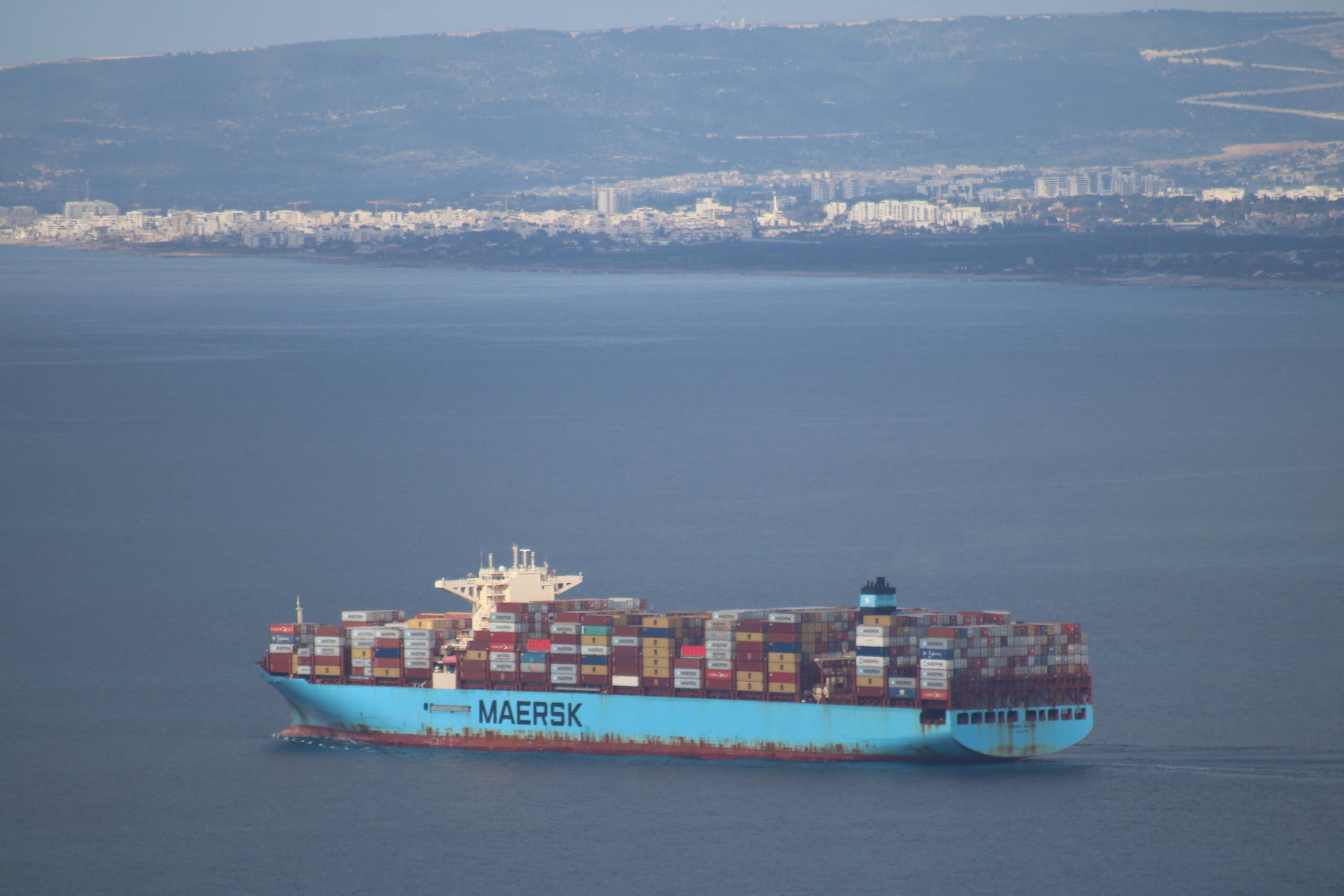
Photo: Courtesy of pho.tography.org
The photograph shows a vast container ship operated by Maersk, one of the world’s largest shipping companies, navigating across calm blue waters. The vessel’s hull is painted in the distinctive light Maersk blue, with the company name emblazoned boldly along its side. Its deck is stacked high with multicolored shipping containers, neatly arranged in rows, each bearing the logos of various global logistics firms. The load stretches nearly the entire length of the ship, emphasizing both the vessel’s enormous carrying capacity and the central role container shipping plays in global trade.
In the background, a coastal city comes into view across the bay, its white and cream-colored buildings catching the light, while green hills rise beyond the urban sprawl, framing the scene with a mix of natural and human landscapes. The contrast between the stillness of the sea and the monumental size of the vessel underscores the quiet power of maritime commerce, where such ships transport the lifeblood of economies—goods, raw materials, and manufactured products—across continents. The faint trail of ripples at the stern shows the ship’s steady progress, a reminder of the ceaseless movement that keeps global supply chains alive.
The event is celebrated worldwide through a mix of conferences, educational campaigns, exhibitions, and port visits, giving maritime communities, governments, and industry leaders the opportunity to reflect on achievements and commit to addressing the challenges ahead. Beyond its ceremonial value, the day provides a platform for policy discussions that shape the future of international shipping, making it not just a symbolic commemoration but also an anchor point for collaboration and regulatory progress.
With shipping responsible for moving close to 90% of world trade, World Maritime Day 2025 will once again remind the global community of the sector’s indispensable role in keeping economies connected. It also underscores the shared responsibility of nations, companies, and individuals to ensure that shipping remains safe, secure, environmentally sound, and resilient in an era of rapid transformation.
Trump’s New Tariff World and Its Impact on Maritime Trade
The global shipping industry, long considered the quiet backbone of international commerce, is once again being thrust into the center of geopolitical turbulence. With Donald Trump’s return to power and his renewed emphasis on tariffs as a tool of economic policy, maritime trade faces a period of significant volatility. Container ships, such as the immense Maersk vessel seen carrying thousands of containers across blue waters, are not just symbols of globalization but also the first casualties when protectionist policies reshape supply chains.
The immediate effect of a tariff-heavy world is a disruption of cargo volumes on key trade lanes. Higher U.S. duties on Chinese goods, for instance, are likely to reduce traffic through major West Coast ports like Los Angeles and Long Beach, cutting into transpacific container flows that have long defined maritime commerce. Some of this volume may be rerouted through Mexico or Canada, while Asian exporters redirect goods to regions less exposed to American trade barriers. As a result, intra-Asia and South–South trade corridors may strengthen while traditional Pacific routes weaken.
Tariffs also create distortions that go far beyond raw volume declines. The uncertainty surrounding their implementation drives erratic shipping patterns: importers rush to front-load cargo before tariffs take effect, only to drastically cut back once the new duties are imposed. This cycle fuels spikes in spot freight rates, equipment shortages, and container imbalances, as some ports overflow while others sit idle. For carriers like Maersk or MSC, it complicates fleet management, disrupts charter markets, and adds volatility to quarterly earnings. Insurance, financing, and hedging costs tend to climb in lockstep, as investors price in the heightened political risk surrounding global trade.
The reshaping of maritime geography is perhaps the most profound consequence. As manufacturers seek tariff havens, investment increasingly shifts toward Vietnam, India, Mexico, and parts of Eastern Europe. This reallocation of production transforms global shipping patterns, with Southeast Asian ports rising in prominence and new feeder routes developing to service emerging hubs. Meanwhile, China’s central role in container shipping may diminish, and transatlantic flows could pivot depending on whether the U.S. chooses to favor certain allies over others.
In the longer term, tariffs encourage companies to fragment global supply chains and rely more on regionalized networks. That means fewer ultra-long-haul voyages linking Asia to Europe or North America, and greater reliance on medium-sized vessels operating on shorter, regional routes. The industry’s reliance on massive container carriers optimized for bulk transpacific and Asia–Europe runs may erode, replaced by a more complex patchwork of regional shipping flows.
Trump’s new tariff world is, at its core, a world of uncertainty. For maritime trade, this means not only adapting to shifting volumes and routes but also confronting the possibility that globalization itself may continue to retreat in favor of regional self-sufficiency. The shipping industry will remain indispensable, but its future map may look very different from the global arteries we have known for decades.
Source: Calendarial.com:
- Network X 2025, October 14–16, Paris Expo Porte de Versailles
- Forrester Technology & Innovation Summit EMEA, 8–10 October 2025, London
- Technosoft Automotive Days 2025, October 7–9, Online
- Apple Ginza Grand Reopening, September 26, Tokyo
- Digital Asset Summit (DAS: London), October 13–15, 2025, Old Billingsgate, London
- The 7th RD20 Conference, September 30 – October 3, 2025, Tsukuba & Online
- Supermicro INNOVATE! 2025: Madrid Becomes the Stage for Next-Gen AI Infrastructure
- European Microwave Week 2025, September 21 to 26, 2025, at the Jaarbeurs Convention Centre in Utrecht, The Netherlands
- Cardano Summit 2025, November 12–13, 2025, Gasometer Schöneberg, Berlin, Germany
- Qlik Connect 2026, April 13–15, 2026, Gaylord Palms Resort & Convention Center, Kissimmee, Florida
Transportational.com::
- Port Houston Receives $25 Million Grant for Agriculture and Community Improvements
- Powering Industry: The Precision of Coal Discharging at Ports
- Navigating Toward a Greener Horizon: The Future of Decarbonizing Maritime Shipping
- Amogy and Mitsubishi Shipbuilding Advance Carbon-Free Maritime Solutions with Innovative Ammonia-to-Hydrogen Technology
- Can U.S. Aircraft Carriers Navigate the Suez Canal Regularly?
- The Persistent Houthi Threat to Maritime Trade: Is the U.S. Response Adequate?
- Venture Global Launches Its First LNG Vessel: The Venture Gator
Leave a Reply