Paul Gauguin’s Arearea (often translated as Joyousness or Pastimes) from 1892 sits in that strange space where painting stops trying to record the world and instead starts building a parallel one out of memory, desire, and selective perception. It belongs to his first Tahitian period, when he left Europe convinced that modern life had become overcomplicated, exhausted, and spiritually diluted. What he found in Tahiti was not simply a new landscape, but a canvas onto which he could project an alternative rhythm of existence, though that projection was already shaped by expectation before he even arrived.
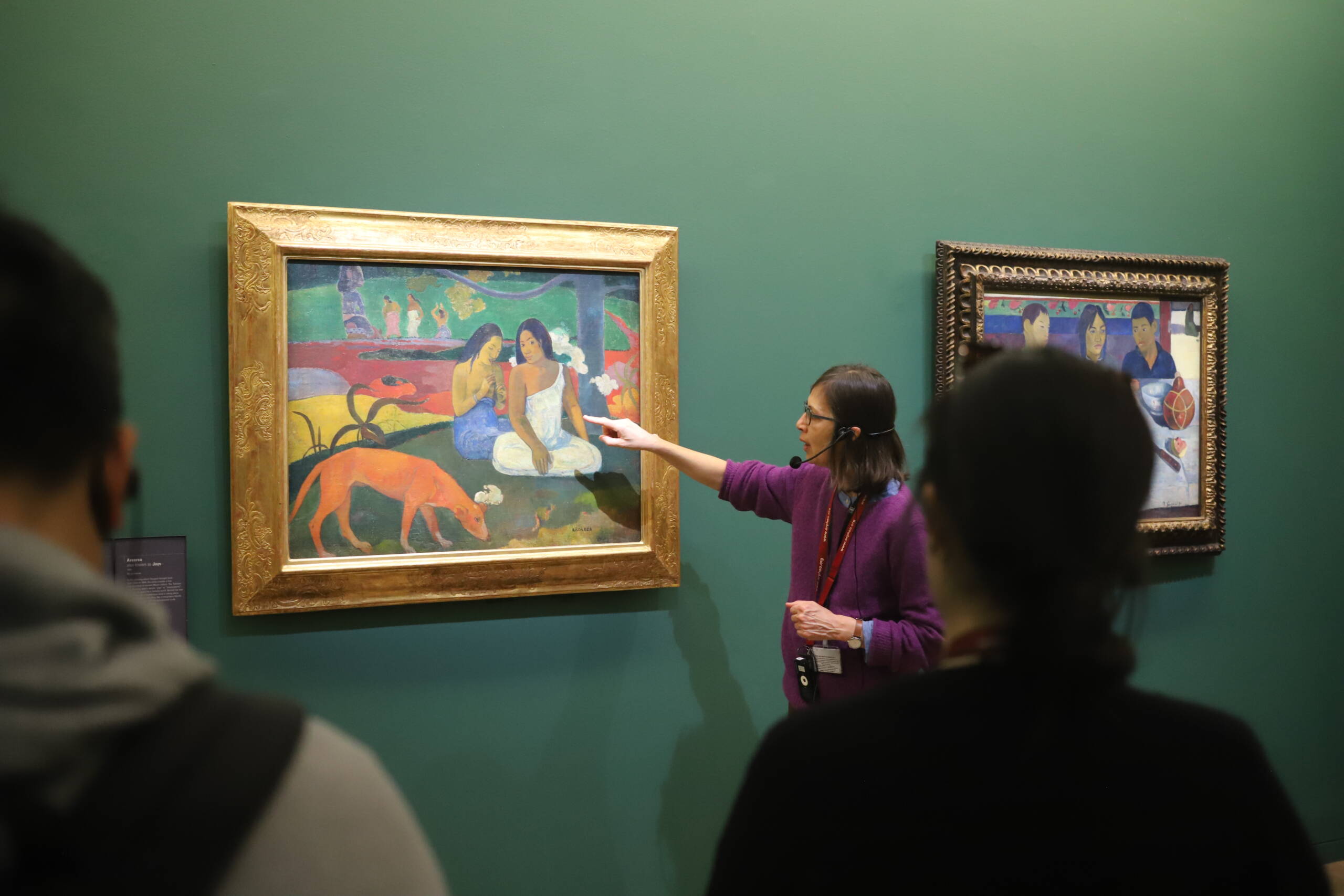
In Arearea, the scene unfolds with a kind of deliberate simplicity that feels almost staged, yet not in a theatrical European sense. Two women sit in the foreground, relaxed, their bodies rendered with soft but firm outlines, occupying space without tension. Nearby, a red dog moves across the ground, and behind them a group gathers in what appears to be a ceremonial or communal moment. The landscape is flattened in typical Gauguin fashion, with large areas of color replacing atmospheric depth, and forms arranged more like symbolic elements than observational reality. There is no attempt to simulate light in the traditional academic sense; instead, color becomes the structure itself.
What makes the painting quietly unsettling, even while it presents itself as harmonious, is this sense of construction. The Tahiti it shows is not ethnographic reality but an invented equilibrium, filtered through Gauguin’s rejection of industrial Europe and his search for something “unspoiled,” a word that in hindsight feels loaded and unstable. The figures are not individualized in the Western portrait tradition; they are more like presences, part of a rhythm that feels both calm and slightly detached from lived immediacy.
The red dog, oddly central in its own way, disrupts any temptation to read the scene as purely idyllic. It introduces a faint tension, a reminder that symbolism is always doing quiet work beneath the surface. Gauguin often used animals, colors, and spatial compression as emotional shorthand, and here the red puncture of the dog becomes almost a signal rather than a naturalistic detail, as if the painting is aware of its own artificiality.
Seen in context, Arearea is less a depiction of Tahiti than a negotiation with Western longing. It reflects Gauguin’s belief that meaning could be recovered through simplification, through stripping away the noise of modernity, but it also reveals how that simplification depends on omission. The result is beautiful, unmistakably so, yet never entirely innocent. It holds a kind of suspended happiness, one that feels composed rather than discovered, and that tension is really where the painting continues to live.