Une rue de Paris en mai 1871 is one of those works that feels strangely quiet at first glance, almost too still for the violence it is tied to. Painted by Maximilien Luce decades after the events it depicts, it reconstructs a Paris street in the aftermath of the Paris Commune, a moment in 1871 when the city was torn apart by civil conflict and then brutally retaken during the “Semaine sanglante.” Luce himself was not a direct witness as an adult artist, yet the scene carries the weight of something half-remembered, filtered through historical accounts, photographs, and a kind of moral imagination that refuses to soften the reality of what happened.
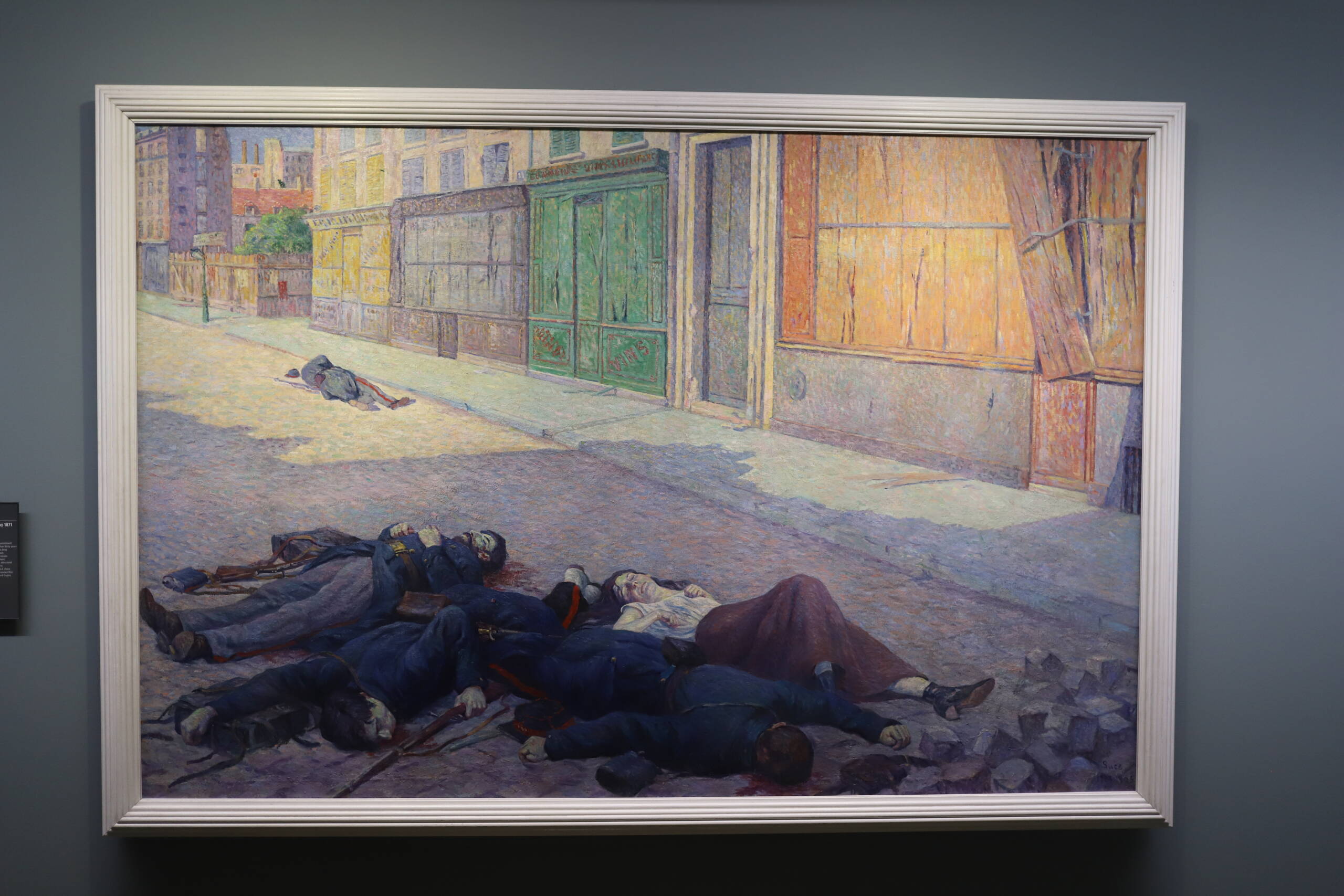
What strikes you most, and it tends to happen slowly rather than immediately, is the tension between the calm structure of the street and the bodies lying across it. The architecture is still there, orderly, almost indifferent: shuttered façades, muted shopfronts, that slightly dusty Parisian geometry that could belong to any ordinary day. But the ground interrupts everything. The scattered figures are not arranged for drama, there is no heroic composition, no triumphant center. Instead, they lie unevenly, awkwardly, as if the moment simply ended and the world did not adjust to it. It has a documentary feeling, even though it is painted, and that ambiguity is part of what makes it linger.
Luce’s technique, which leans toward neo-impressionist clarity rather than theatrical brushwork, keeps emotion restrained at the surface. Yet that restraint doesn’t neutralize the subject; it sharpens it. The pale light, the slightly washed tones of the pavement, and the almost clinical spacing of forms give the scene a disquieting neutrality. It is not shouting tragedy at you, which somehow makes it harder to ignore. The historical reference is direct, but the painting resists becoming illustration—it sits somewhere between witness and reconstruction.
There’s also something unsettling in how ordinary the street still looks. Life hasn’t fully left the frame, even if it has clearly been interrupted. That tension, between continuation and collapse, is where the painting really lives. Luce, who had strong political sympathies and was connected to anarchist circles, seems less interested in spectacle and more in the afterimage of conflict—the moment when ideology and history stop moving and only the physical residue remains.
In a way, it’s not really about 1871 as a date anymore, but about how cities remember violence without changing their shape. You could walk through Paris today and still feel the ghost of that structure, even if you’d never know the exact corners. And maybe that’s what makes the work stick: it doesn’t reconstruct a battle, it reconstructs absence, which is a quieter and, oddly, more persistent kind of memory.