Inside the halls of the Musée d’Orsay there is a sculptural group that tends to stop people a little longer than expected, partly because it feels like it is doing more than simply showing an ancient scene. The work is by Jean-Léon Gérôme, and it belongs to his long, almost obsessive engagement with the Roman arena, especially gladiatorial spectacle and the visual drama of judgment and defeat. What you are looking at is typically identified within his broader gladiator cycle, often discussed alongside works like Pollice Verso and related sculptural studies, where he translates painted imagination into three-dimensional form with an almost theatrical precision. The composition shows a victorious gladiator standing over a fallen opponent, the bodies arranged with that deliberate clarity Gérôme was known for, where every gesture feels staged but still oddly weighty, as if history has been reconstructed rather than merely depicted.
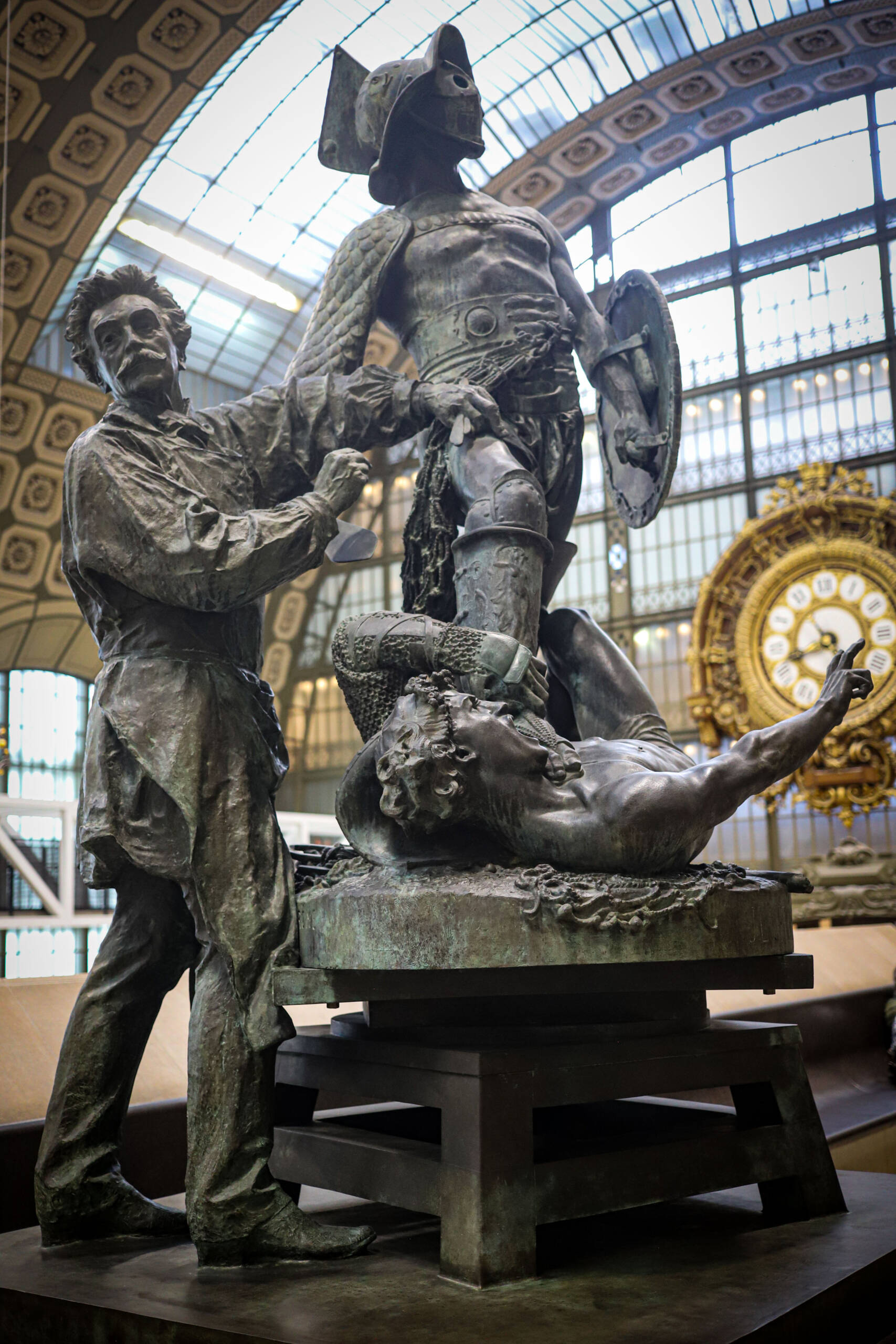
The modern-looking figure standing to the side is where interpretations sometimes drift into more speculative territory. Gérôme did not usually insert himself literally into his Roman scenes, at least not in a clearly documented self-portrait sense in this particular group, though he very often positioned the artist implicitly as observer, arranger, almost director of antiquity. What tends to happen with works like this is that viewers begin to read the presence of modernity into any figure that feels slightly detached from the mythic space of Rome, and that reading is understandable because Gérôme’s whole project was about collapsing the distance between archaeological imagination and nineteenth-century visual certainty. The ancient arena is reconstructed with such controlled realism that it begins to feel like something staged in a studio rather than recovered from history, and that tension is really the point of his practice.
Seen in that light, the piece aligns closely with his wider body of work on Roman spectacle, including Pollice Verso, where the crowd’s gesture of judgment becomes almost more important than the violence itself. The real subject is not only gladiators but the act of looking at them, the way spectatorship constructs antiquity as something both distant and vividly present. Gérôme’s Rome is never purely historical; it is filtered through academic precision, modern theatricality, and a kind of visual certainty that makes the past feel engineered. Whether or not one reads any autobiographical insertion into the scene, the stronger reading is that the artist’s presence is everywhere and nowhere at once, embedded in the composition’s control over what is shown and what is withheld, which is very much the signature of his Victorian-era vision of antiquity.